
Before committing extensive analytical resources to a problem-solving initiative, leadership must first establish whether an acute operational crisis exists and immediately erect containment safeguards. Rigorous problem scoping and classification represent the ultimate defense against squandering enterprise resources on ambiguous symptoms or disguised remedies.
How 20% of Vital Few Drivers Yield 80% of Business Outcomes
Immediate Reaction Plans: Triage Containment versus Root-Cause Cure
An Immediate Reaction Plan denotes rapid, provisional containment countermeasures deployed instantly to halt damage, isolate defective output, and protect external stakeholders. The primary mission is damage containment and operational quarantine, establishing safety before forensic investigation begins.
Contrasting Immediate Containment with Root-Cause Countermeasures:
• Case 1 - Shopfloor Factory Fire: Immediate Reaction: Suppressing the flames with fire suppression systems and evacuating personnel. | Systemic Solution: Forensically investigating electrical short-circuits and flammable vapor buildup, refactoring wiring conduits to prevent recurrence.
• Case 2 - Severe Adverse Drug Reaction Detected: Immediate Reaction: Executing an immediate nationwide recall across all hospital and retail pharmacy inventories. | Systemic Solution: Investigating biochemical batch contamination or formulation instability, implementing real-time chromatography monitoring.
• Case 3 - Contagious Pathogen Outbreak: Immediate Reaction: Quarantining affected patients and initiating immediate palliative care. | Systemic Solution: Developing targeted immunological vaccines, genomic surveillance, and public sanitation protocols.
The Three Stages of Containment Governance:
1. Formulating Containment Actions: Rapidly designing low-friction, high-protection temporary barriers.
2. Rapid Deployment: Mobilizing cross-functional resources with unambiguous individual accountability and executive sign-off.
3. Containment Auditing: Continuous monitoring of the containment perimeter until permanent root-cause countermeasures are verified.
Practical Immediate Reaction Plan Drills:
• Drill 1: Simulate an acute operational or quality emergency in your workplace and design a comprehensive immediate containment protocol to quarantine the defect.
• Drill 2: Within a cross-functional project team, formulate a documented reaction containment plan to mitigate severe operational risks before project launch.
• Drill 3: Analyze operational case scenarios to determine when an immediate reaction containment plan is more crucial and time-sensitive than protracted long-term planning.
Occam's Razor: Stripping Away Complexity to Expose Core Problems
Occam's Razor is a classical philosophical principle of parsimony adapted by Simprago to distill problem definitions down to their absolute essentials, eliminating distracting rhetoric and organizational politics.
To avoid falling into the three cardinal traps of problem scoping: A) Presumed solutions disguised as problem statements, B) Overly broad generalities, and C) Conflicting stakeholder biases, teams execute the following four-step protocol:
1. Prominently display the draft problem statement where all team members can inspect it, providing each participant with blank writing cards.
2. If the statement hints at a predetermined remedy, apply the golden interrogative: "If we possessed [X], what foundational business breakdown would actually be resolved?" (Watch closely for solution-implying words such as more, less, better, upgraded, automated).
Worked Example: Draft Statement: "We need a larger warehouse." -> Occam's Interrogative: "If we had a larger warehouse, what foundational breakdown would actually be resolved?" -> Discovery: The real issue is excessive inventory holding and poor inventory turnover, not floor space.
3. If the statement is an overly broad generality, apply the second interrogative: "What specific core disruption does [Y] inflict upon our organizational performance?"
Worked Example: Draft Statement: "Poor inter-departmental communication." -> Occam's Interrogative: "What specific core disruption does poor communication inflict?" -> Discovery: Delayed engineering change notices causing 18% scrap spikes on line 3.
4. Consolidate responses, cluster themes, and reach explicit consensus on the factual problem boundary.
Additional Field Applications of Occam's Razor:
• Example 1: "Hire 5 additional sales associates." -> Interrogative reveals that revenue declined because quotation turnaround time averaged 6 days instead of 24 hours.
• Example 2: "Expand restaurant menu variety." -> Interrogative reveals that average ticket size fell because lunch rush preparation times exceeded customer lunch breaks.
• Example 3: "Build an AI dispatch system for ecommerce deliveries." -> Interrogative reveals high customer dissatisfaction driven by carrier delivery window inaccuracy, not routing algorithms.
The Four Guidelines for Problem Screening & Triage
Before accepting an issue into the formal problem-solving pipeline, evaluate it against the Four Guidelines. Only commit resources when all four questions yield an affirmative response:
1. Does this dilemma reside within our operational authority and sphere of influence? (Eliminates chasing issues outside organizational control).
2. Can we execute meaningful, measurable resolution within a viable timeframe? (If a project requires 6 months to solve but the operational mandate expires in 4 weeks, alternative triage is required).
3. Can objective, verifiable empirical data be gathered? (Problems must be solved on empirical evidence and physical measurements, not subjective speculation).
4. Does the organization genuinely possess the strategic conviction to resolve it? (The "So What?" test—ensuring the dilemma generates tangible business value rather than academic intrigue).
The Four Questions Technique and the Famous Pontiac Case
The Four Questions technique provides a surgical diagnostic grid to bound a problem across four orthogonal axes: What, When, Who, and Where. Each question must be interrogated both in the positive (Where does it occur?) and the negative (Where does it NOT occur?):
The True Classic Investigation: The Pontiac That Was Allergic to Vanilla Ice Cream
A Chevrolet Pontiac owner sent an extraordinary complaint letter to General Motors: "Every time I buy vanilla ice cream, my car will not start when I return to the vehicle. But whenever I purchase chocolate or strawberry ice cream, the engine starts instantly!"
While many would dismiss the complaint as absurd, GM's chief engineer accompanied the customer to investigate using the Four Questions framework:
• What: The engine cranks but fails to ignite immediately after purchasing vanilla ice cream. It starts normally after purchasing other flavors.
• When: Occurs on every vanilla purchase. Does NOT occur on chocolate or strawberry purchases.
• Who: Independent of driver technique or operational habits.
• Where: Occurs in the parking lot of the ice cream parlor.
The Forensic Breakthrough: The engineer discovered that vanilla was the store's best-selling flavor, stored in a quick-grab freezer at the front of the counter. Purchasing vanilla took less than 2 minutes, whereas purchasing chocolate or strawberry took over 10 minutes. Because the engine sat idle for only 2 minutes after high-speed highway driving, engine heat soaked into the fuel manifold, boiling the fuel and creating Vapor Lock. When the customer bought chocolate, the 10-minute delay gave the engine sufficient time to cool down. The problem was not culinary—it was thermal engineering!
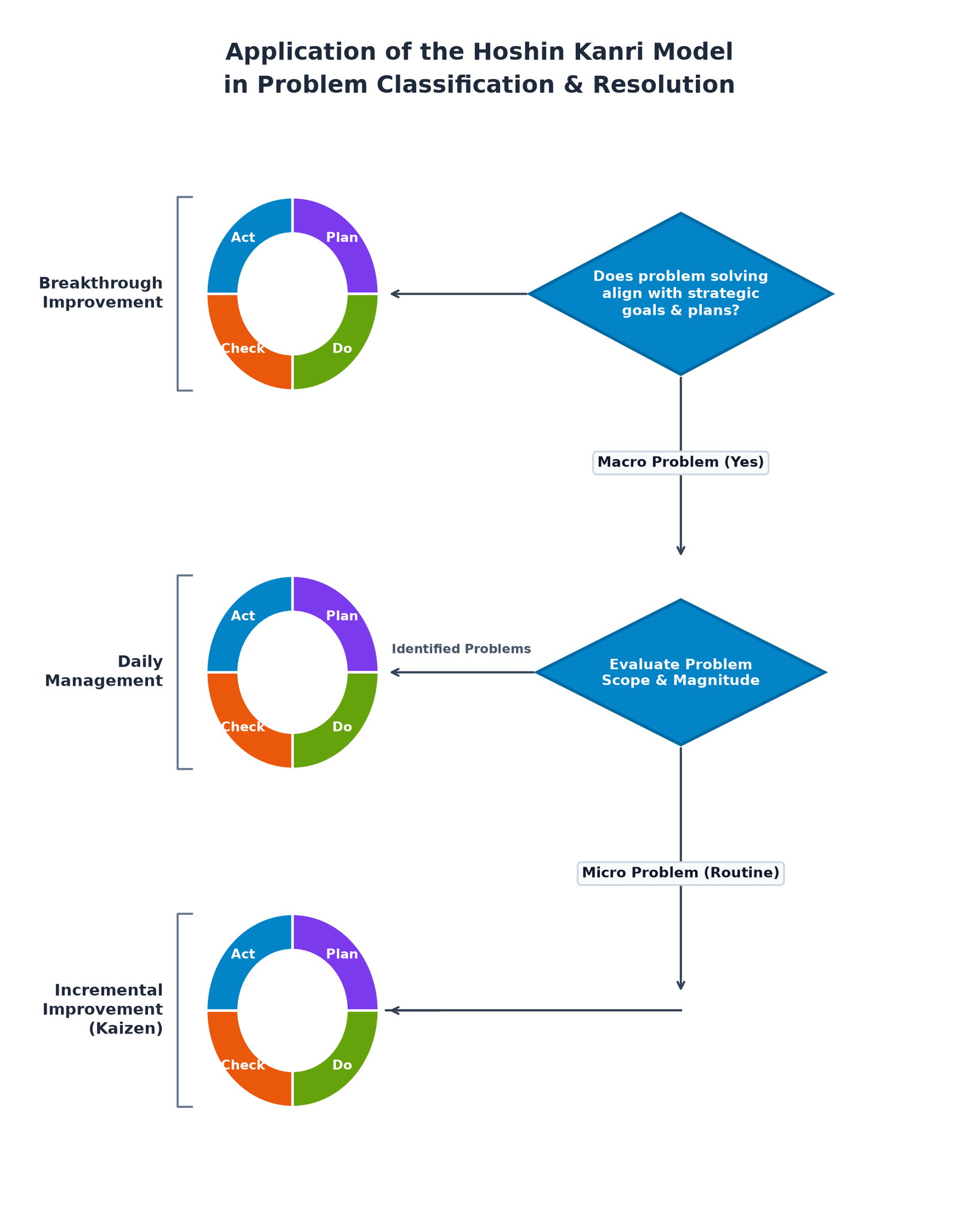
Hoshin Kanri: Classifying Macro versus Micro Dilemmas
The Japanese Hoshin Kanri framework enables leadership to decouple enterprise challenges into two distinct operational tiers:
1. Macro Level: Strategic breakthrough targets and transformative organizational objectives aligned with long-term company vision.
2. Micro Level: Routine daily shopfloor management, standard operating stabilization, and frontline Kaizen activities that support macro milestones.
The diagram below illustrates the Hoshin Kanri classification and resolution workflow based on the PDCA cycle:
The MUDA Doctrine: Rooting Out the 7 Forms of Lean Waste
MUDA is the Japanese term for "waste" or "futility" and represents the foundational pillar of the Toyota Production System (TPS) and Lean Manufacturing. Simply stated, any operational activity that consumes resources without generating value recognized by the customer constitutes MUDA.
Resources Consumed: Labor hours, machine uptime, tooling, capital, energy, raw materials, and floor space.
Value Created: Specific attributes that the paying customer genuinely values—conforming quality, dependable delivery, and competitive pricing.
The Classic Seven Wastes (MUDA) in Enterprise Operations:
1. Overproduction: Manufacturing ahead of customer demand or producing volumes beyond current consumption.
2. Waiting: Operator or machine idle time caused by bottleneck starvation, equipment downtime, or delayed sign-offs.
3. Unnecessary Transportation: Wasteful movement of materials, tooling, or inventory caused by suboptimal plant layouts.
4. Overprocessing: Performing redundant, non-value-adding operational steps due to flawed tooling or obsolete specifications.
5. Excess Inventory: Surplus raw materials, WIP, and finished goods that tie up working capital and conceal operational defects.
6. Unnecessary Motion: Ergonomically wasteful operator movements, such as searching for tools, drawings, or parts.
7. Defects and Scrap: Rework, scrap generation, and warranty claims resulting from process instability.
7. Practical Chapter Workshops and Drills
To master problem identification, screening, and classification techniques in practice, teams should execute the following structured drills:
A) Occam’s Razor Workshops:
• Drill 1 (Returning to the Core Dilemma): Audit your organization’s active backlog of issues. Identify statements that represent solutions disguised as problems. Deploy Occam’s interrogative ("If we possessed [X], what core problem would actually be resolved?") to reframe at least one issue into a clear, factual problem statement.
• Drill 2 (Deconstructing Complex Systems): Select a convoluted multi-variable issue and decompose it into discrete sub-problems. Apply Occam’s parsimony to identify the simplest viable solution hypothesis for each sub-problem.
• Drill 3 (Four Guidelines Screening Matrix): Screen an active organizational project against the Four Guidelines: 1) Within organizational authority? 2) Resolvable within a viable timeframe? 3) Backed by objective data? 4) Genuine executive commitment? Document clear rationales for each dimension.
B) The Four Questions Drills:
• Drill 4 (Boundary Mapping): Select an active operational defect and deconstruct it across the Four Questions (What, When, Who, Where), rigorously contrasting where the failure occurs versus where it does NOT occur.
• Drill 5 (Refined Definition Comparison): Contrast the refined problem statement generated through the Four Questions against the preliminary draft, detailing how diagnostic focus shifted.
• Drill 6 (Post-Mortem Diagnostic Evaluation): Review a completed historical problem investigation and evaluate whether applying the Four Questions would have compressed diagnostic lead time.
• Drill 7 (Cross-Functional Convergence Session): In a team meeting, have members independently answer the Four Questions for a shared challenge and converge disparate views into a single unified problem definition.
C) Hoshin Kanri Stratification Drills:
• Drill 8 (Macro vs. Micro Classification): Over a two-week span, catalogue all incoming operational demands and classify them into Macro (strategic, breakthrough, long-term) versus Micro (daily maintenance, routine Kaizen, localized).
• Drill 9 (Calendar & Workload Calibration): Using a workload tracking tool (e.g., Trello or Excel), segment daily time allocation between Macro strategic priorities and Micro operational tasks, observing the impact on throughput.
• Drill 10 (Bi-Weekly Retrospective): Compare performance outcomes against baseline methods across productivity, milestone adherence, and strategic alignment, identifying three core avenues for continuous improvement.
D) MUDA Waste Elimination Drills:
• Drill 11 (Shopfloor Waste Audit): Identify three distinct instances of the Seven Wastes (MUDA) in your physical or digital work environment and architect an action plan to eradicate them.
• Drill 12 (Project Resource Bottleneck Analysis): Analyze an active project to uncover latent resource idling, waiting time, or redundant approvals.
• Drill 13 (Workflow Scrap & Overprocessing Review): Examine an operational workflow to eliminate redundant handoffs, excessive documentation, or staging buffers.
• Drill 14 (Team Waste-Hunting Brainstorming): Facilitate a dedicated team brainstorming session to catalogue hidden operational wastes within the department.
• Drill 15 (Personal Ergonomic & Workflow Streamlining): Audit individual daily routines to compress non-value-adding administrative friction and repetitive motion.
3 Core Takeaways for Problem Solvers
Pareto proves that 80% of waste stems from a vital 20% of root causes.
Align problem-solving initiatives with corporate strategy via Hoshin Kanri.
Focus concentrated team power on the vital few rather than trivial multitude.
1. Occam's Razor (Lex Parsimoniae) is an analytical principle attributed to the 14th-century English philosopher William of Ockham, asserting that simpler explanations with fewer assumptions are preferable to convoluted hypotheses.
2. The MUDA waste-reduction framework was pioneered in the 1950s by Taiichi Ohno and Shigeo Shingo at Toyota Motor Corporation as part of the Toyota Production System (TPS).