
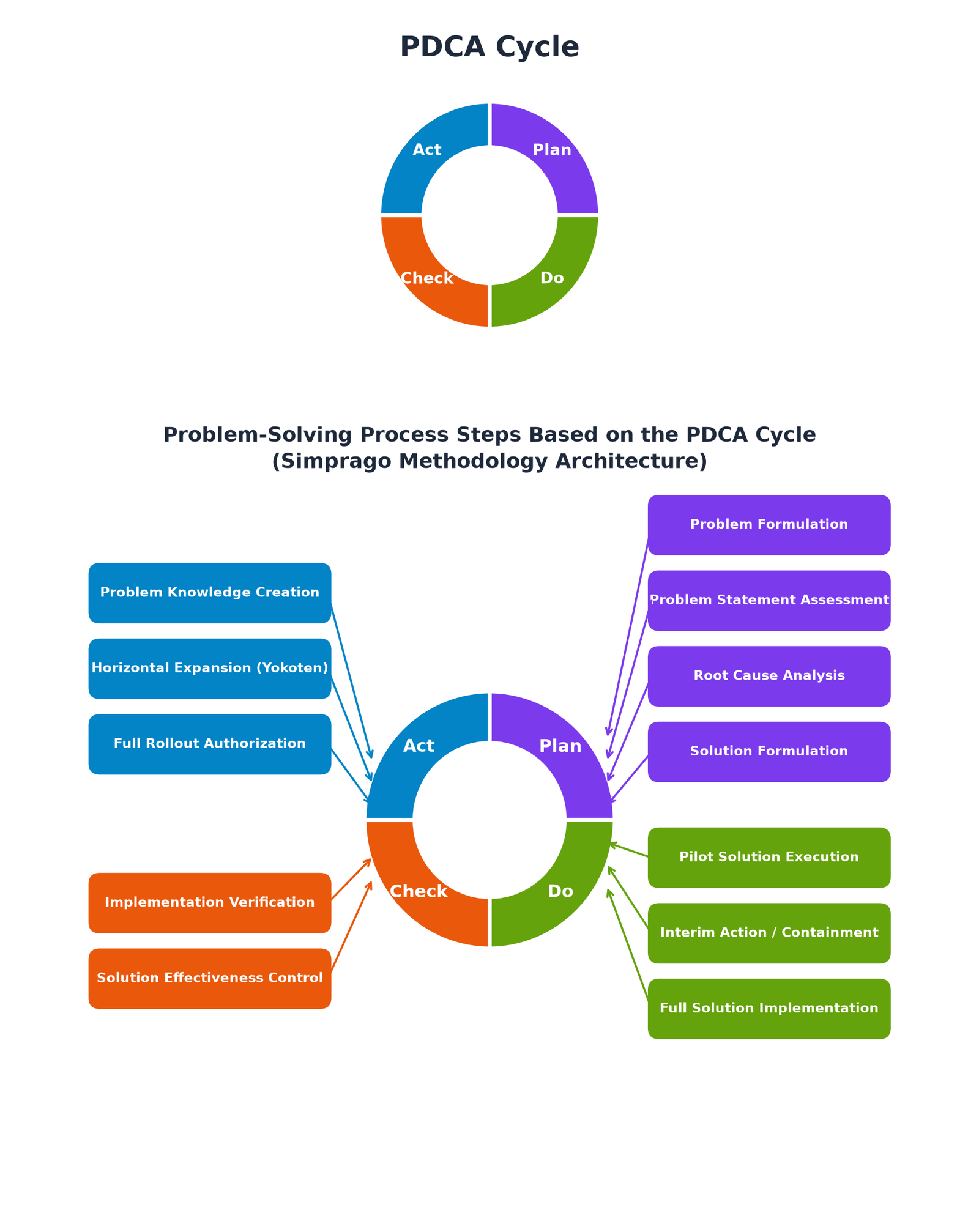
The overarching process architecture of the Simprago methodology is built upon the classic management cycle pioneered by Dr. W. Edwards Deming, universally codified as PDCA: Plan, Do, Check, and Act. Within Simprago, this four-phase engine is enriched into an industrial-grade operational roadmap where problem formulation, containment, root-cause forensics, and institutionalization operate in seamless harmony.
Interactive PDCA Cycle mapped to the 14 Simprago Steps
Plan Phase - Steps 1 to 5
Identification to RCAThe Deming Cycle (PDCA) and Process Architecture
The foundational engine of Simprago problem solving is anchored in Dr. W. Edwards Deming's PDCA cycle. Every phase of our 14-step framework is calibrated against this four-stage governance model, ensuring disciplined momentum from initial diagnosis to enterprise-wide standardization.
The schematic below outlines the core PDCA cycle alongside the comprehensive step-by-step Simprago problem-solving architecture:
PDCA or PDSA? Conceptual Harmonization
In certain operational literature, the acronym PDSA is utilized, where "S" stands for Study, replacing Check. Deming himself favored Study in his later writings to emphasize intellectual reflection over bureaucratic audit.
Both variations represent the same underlying truth. Proponents of PDSA note that "Study" conveys a deeper, more comprehensive analytical mindset and avoids the punitive connotations sometimes associated with the word "Check". In enterprise practice, however, PDCA remains the globally recognized industrial standard, and Simprago utilizes this universal nomenclature throughout.
Broad-Spectrum Applications of the PDCA Cycle
PDCA has established a legendary footprint across modern commerce, underpinning continuous Kaizen improvement, risk management systems, ISO quality standards, and agile operations.
Yet the true power of PDCA extends far beyond manufacturing shopfloors. Internalizing this four-stage mental model fundamentally transforms how leaders perceive reality, separating decision-making into an enlightened "before and after". As illustrated in the following practical cases, PDCA serves as a universal compass for de-risking high-stakes initiatives.
Deconstructing PDCA Through an Everyday Case: The Household Rice Purchasing Dilemma
To demonstrate the universal elegance of the PDCA engine, consider an everyday consumer scenario familiar to households across the region—procuring premium staple rice:
Stage 1: Plan (Specification Framing)
The homemaker compiles a precise specification list for the family's staple rice: grain elongation, aroma, cooking tenderness, and total required volume. The spouse incorporates an essential operational constraint—a budget ceiling—before visiting the marketplace.
Stage 2: Do (Pilot Sampling)
At the market, the buyer compares available vendor batches against the functional criteria. Crucial tactical dilemma: Does the buyer immediately purchase the full bulk volume? A novice might, but an experienced practitioner knows the latent risk of variance and purchases a small, low-risk test sample sufficient for a single trial cook.
Stage 3: Check (Empirical Verification)
The test sample is cooked and evaluated against the original criteria, yielding one of two operational outcomes:
1. The sample satisfies all culinary standards, granting authorization to proceed to bulk purchase.
2. The sample reveals deficiencies and fails verification, triggering a disciplined return to upstream stages:
• Scenario 2-A (Plan Defect): Key requirements were omitted during initial specification (e.g., forgotten broken grain percentage). The buyer returns to Plan, refines the specification checklist, and requests a new vendor sample.
• Scenario 2-B (Execution Defect): Specifications were communicated correctly, but the supplier batch was substandard. The buyer either demands an alternative batch or switches to an alternate supplier, repeating the pilot test until full verification is achieved.
Stage 4: Act (Standardization & Bulk Deployment)
With empirical verification secured, the bulk order is executed with zero financial waste, codifying the supplier into the household's preferred vendor registry.
Core Lessons for Enterprise Problem Solving:
• Lesson 1: Precision in initial requirement scoping drastically reduces expensive downstream rework.
• Lesson 2: Verification of supplier process capability is mandatory before committing full execution resources.
• Lesson 3: Low-risk pilot sampling is an indispensable shield against enterprise-scale blunders.
Cross-Industry Manifestations of the PDCA Engine
Case 1: Launching a Specialized Restaurant Venture
• Plan: An entrepreneur defines culinary concept, target demographic, seating capacity, interior architecture, and budget parameters.
• Do: Negotiates initial supplier contracts, constructs a test kitchen, and formulates an experimental tasting menu.
• Check: Conducts an invite-only soft opening to harvest diner feedback on dish consistency, acoustics, and service cadence. Discrepancies prompt immediate recipe and workflow adjustments.
• Act: Codifies perfected recipes and service checklists into staff manuals, initiating full commercial operations backed by ongoing guest feedback loops.
Case 2: Launching an Enterprise Mobile Productivity Application
• Plan: Software product managers define functional user stories, calendar synchronization, security parameters, and sprint milestones.
• Do: Engineers develop an MVP and distribute a private beta release to a closed cohort of 200 power users.
• Check: Telemetry data and user interviews reveal friction in onboarding and cloud synchronization. Developers loop back to Plan to refactor UI navigation.
• Act: Following verified beta stability, the production release is launched globally, backed by automated crash-reporting pipelines.
Case 3: Customer Service Transformation in Retail Banking
• Plan: Branch directors analyze queueing bottlenecks and set a target to compress average customer wait time from 22 minutes to under 7 minutes.
• Do: Deploys a digital triage kiosk and trains a pilot squad of customer concierges in two high-traffic branches for 30 days.
• Check: Daily analytics indicate average wait times fell to 5.4 minutes, while customer NPS increased by 38%.
• Act: The concierge triage protocol is formalized into official banking SOPs and scaled across all national branch networks.
The Strategic Weight of the Planning Phase: The 70/30 Rule
These real-world cases demonstrate that PDCA is the universal lifeblood of organizational agility and systematic improvement.
Decades of industrial data and Simprago empirical research reveal a foundational law: in the PDCA cycle, the overwhelming lion's share of intellectual effort, analytical rigor, and resources must reside in Phase P (Plan).
It is in Phase P that problems are rigorously scoped, data is forensically analyzed, root causes are verified, and robust countermeasures are architected. It is no exaggeration to assert that Phase P commands 70% of the total problem-solving effort, while the remaining 30% is distributed across Do, Check, and Act. Get the planning right, and execution becomes straightforward; rush the planning, and execution degenerates into chaos.
3 Core Takeaways for Problem Solvers
The PDCA cycle provides the disciplined compass guiding all 14 Simprago steps.
Never skip steps; rushing prematurely into solutions guarantees problem return.
Management by facts and verifiable field metrics replaces hierarchical guesswork.
1. Dr. W. Edwards Deming (1900–1993) was an American statistician, author, and quality pioneer whose teaching on statistical process control and the PDCA cycle ignited Japan's post-war industrial miracle, laying the foundations for Total Quality Management (TQM).