
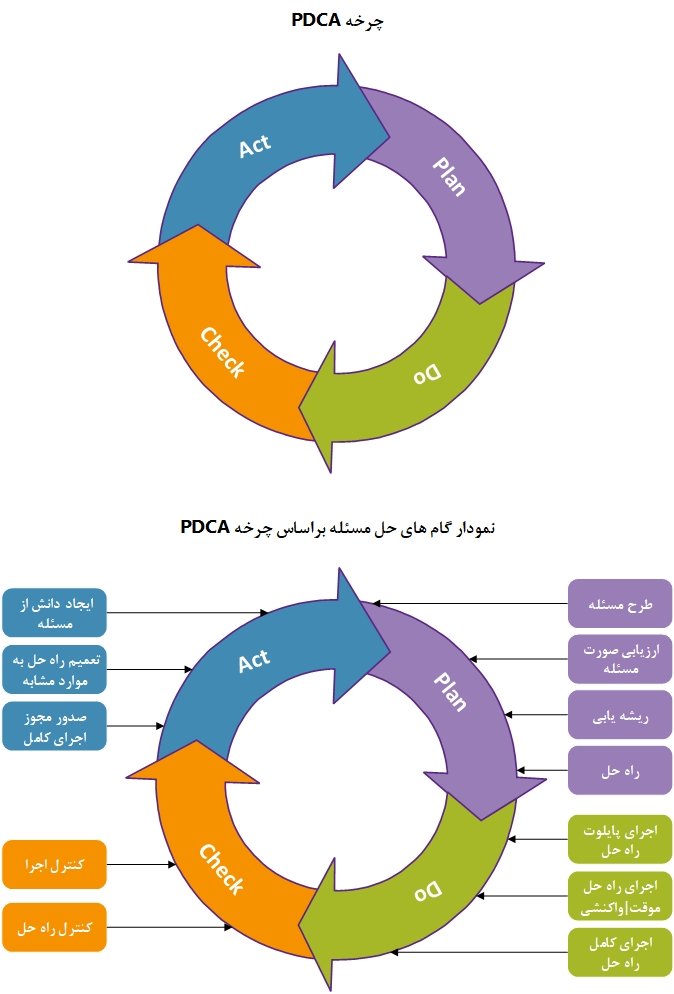
Simprago's overall problem-solving structure is based on Edward Deming's well-known cycle, abbreviated PDCA.
Footnote: Edward Deming (1900–1993) was an American statistician and quality management specialist recognized as a founder of the philosophy of total quality management. Through principles such as PDCA and Deming's 14 principles, he played a key role in improving Japanese manufacturing quality after World War II.
PDCA stands for Plan, Do, Check and Act: planning, implementation, control and institutionalization.
Some sources use PDSA instead. Here S stands for Study, replacing Check.
Naturally, using either word does not change the cycle's nature. Those preferring Study argue that it is more comprehensive and lacks the negative connotation of Check as control. Ultimately, PDCA is more common and better known, and this is the name we use in this book.
Applications of PDCA
PDCA has well-known business applications, including continuous improvement, problem solving, risk analysis, system planning and quality management.
Its applicability, however, appears to extend far beyond business.
A deep understanding of this cycle gives you an outlook and insight that can be applied in every area of life.
You will find that your view of the surrounding world divides into before and after deeply understanding this cycle.
The examples that follow will make this more tangible.
The meaning of PDCA and its application to problem solving
Explaining PDCA through an example:
Rice occupies a large place in Iranian meals and diets, so buying it is important.
The usual rice-buying process is as follows:
Step one: Plan
The woman of the household gives her husband a list of requirements and desired rice characteristics: good taste, good cooking performance, aroma, elongated cooked grains and the quantity required.
Her husband adds a price range to these requirements and visits a store or supplier.
Step two: Do
To buy, the specified characteristics must be compared with the store's or supplier's options and the best available choice selected.
First important question: after selecting from the seller's options, how much should the husband buy?
The simple answer is the amount his wife requested.
But an Iranian man knows the risks from experience and asks for a small sample, enough for one cooking and use.
Step three: Check
His wife evaluates and tests the sample, with one of two outcomes:
- She approves the sample, and the next step proceeds.
- The sample has defects and is not approved. Earlier steps must therefore be revisited to correct them.
- If some desired characteristics were omitted when ordering, return to the first step and revise the requirements list. In our example, the wife forgot to specify no broken grains, or a low proportion of them. After completing the requirements, another sample is requested according to the latest revision.
- If something went wrong in purchasing the sample—that is, the requirements were stated correctly but the sample lacked them—request another sample or change sellers and obtain one elsewhere.
Repeat this step until the sample is approved.
Step four: Act / institutionalize
Once the initial sample is approved, buy the requested quantity.
Important point 1: the more carefully initial requirements and expected characteristics are examined and listed, the lower the likelihood of rework.
Important point 2: when implementing a solution, ensure the right option has been selected and can meet the requirements.
Important point 3: purchasing an initial sample and repeating this until approval is very important.
Other examples explaining PDCA (the Deming cycle) and its application:
Example 1: opening a restaurant
Step one: Plan
An entrepreneur decides to open a restaurant and specifies its requirements and characteristics, including food type, location, decor and budget.
Step two: Do
The entrepreneur looks for a suitable location and sources ingredients, negotiates with suppliers and designs an initial menu.
Step three: Check
After opening, the entrepreneur collects customer opinions and evaluates food and service quality. If problems exist, they return to the first step and revise the menu or services.
Step four: Act / institutionalize
After making changes, the entrepreneur continues improving the restaurant and uses the experience gained to develop the business.
Example 2: launching a mobile application
Step one: Plan
A software development team decides to launch a time-management mobile app. They specify requirements and features, including the user interface, functions such as reminders and a calendar, and intended use. They also set a development budget and schedule.
Step two: Do
The team begins designing and coding the app. After the initial stages, it releases a pilot version to selected users to collect initial feedback.
Step three: Check
The team contacts selected users and examines their opinions and experiences. If there are performance problems or unmet user requirements, it returns to earlier steps and revises features, design or defects.
For example, users might complain that the interface is too complex.
Step four: Act / institutionalize
After changes based on feedback, the final app is prepared and released. The team continues gathering user feedback for further improvements.
Example 3: improving customer service in a store
Step one: Plan
A store manager decides to improve customer service and identifies existing requirements and problems, such as long waiting times and dissatisfaction. The objectives are to reduce waiting and increase satisfaction.
Step two: Do
The manager implements a customer-service improvement pilot, training a small group of employees to try new methods and beginning to monitor waiting times. The pilot runs for one month.
Step three: Check
After the pilot, the manager gathers customer opinions and waiting-time data, examining whether the changes improved satisfaction. If results are not positive, they return to earlier steps, design new strategies and correct potential shortcomings.
Step four: Act / institutionalize
After evaluating the pilot's success and making necessary changes, the manager trains all employees in the new methods and adopts them formally. Customer feedback continues to be gathered to improve service.
These examples show how PDCA can support continuous improvement in any kind of business.
Experience and various sources indicate that most activity and attention in PDCA belongs to phase P: defining the problem correctly, analyzing it and identifying its roots using problem-solving methods and techniques, and finding a solution.
It is no exaggeration to assign phase P 70 percent of the weight, with the remaining 30 percent divided among implementation, checking and institutionalization.