
Table of Contents
The Pride Doctrine
History
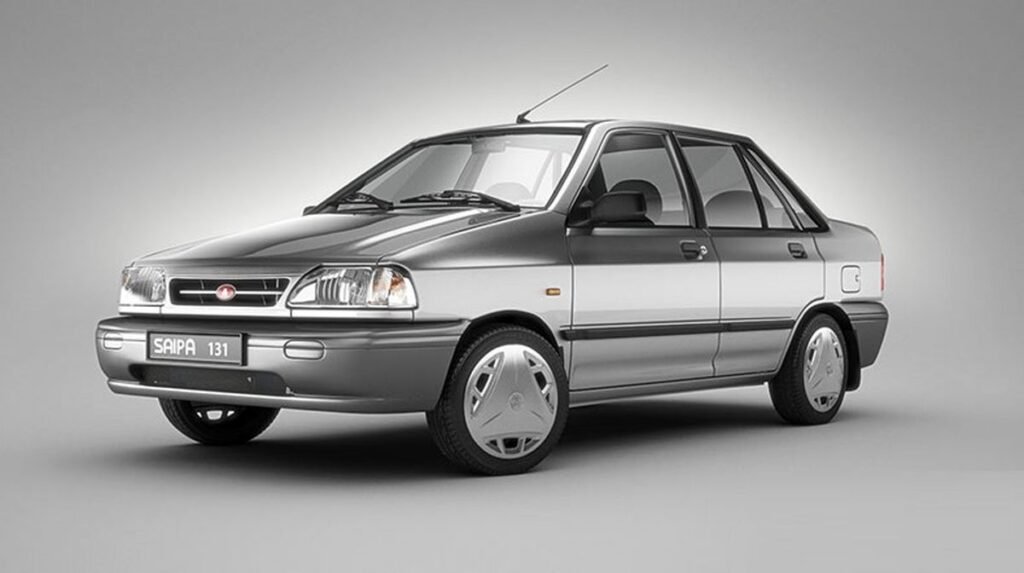
The Pride was originally designed by Japan's Mazda at the request of Ford in the United States. The first generation was produced from 1986 to 1993 and sold in Japan as the Mazda 121, and in North America by Ford as the Ford Festiva.
The car was produced by South Korea's Kia Motors from 1987 to 2000 under the name "Kia Pride," and its production line was sold to Saipa in 2001.
The company Saipa sought to localize production of the Pride by establishing a chain of technical parts manufacturers within the Saipa Group and supporting private-sector parts manufacturers. It offered various models in Iran under the names Nasim (Pride hatchback), Saba (Pride sedan), Saipa 132, Saipa 131, Saipa 111, Saipa 141 and the Pride pickup (Saipa 151).
In Aban 1398 in the Iranian calendar, Saipa announced that the process of ending Pride production had begun in Bahman 1397 and that the car would be completely phased out by Tir 1399. Accordingly, production of the Saipa 132 would stop in Dey 1398, the Saipa 111 in Ordibehesht 1399 and the Saipa 131 in Tir 1399.
Source: Wikipedia
What Is the Issue?
In recent years, media and social networks have been full of criticism, jokes and mockery of the Pride. It was as though many politicians and celebrities considered attacking this car part of their social responsibility.
But is this car really so bad and of such poor quality?
In my view, no; it is actually a very good car.
When I worked in this car's supply chain and the auto-parts industry, around 700 suppliers in the country were involved in supplying its parts. Each of those 700 suppliers, in turn, was connected to and worked with dozens of lower-tier suppliers.
Direct and indirect employment in the automotive industry has been estimated at around one million people (source: Donyaye Khodro website), but I believe there are more indirectly employed people who have not been counted.
After leaving the auto-parts industry in the Iranian year 1383, I had the opportunity over 15 years to travel to most regions of Iran as a consultant, trainer and provider of management software. I visited more than one hundred companies working in different fields and became closely acquainted with their activities.
Here, I would like to share the results of my observations and studies with you.
Among the fields I observed, Iran's automotive industry has, without exaggeration, the most advanced, up-to-date and highest-quality system, with a significant lead over other sectors. If we gave the automotive industry 70 out of 100, the closest sectors, such as steel, oil and petrochemicals, would score no more than 50. At the bottom of the ranking are sectors whose names would surprise you, but they are not the subject of this discussion.
Remember that this is only a relative comparison, and the following points must be considered:
- A car consists of approximately 5000 parts, and anyone familiar with technical matters knows what that means!
- The strictest standards and most extensive industry system requirements probably rank as follows:
1- Aerospace industries
2- Military industries
3- Shipbuilding industries
4- Automotive industry
5- Home appliance industry
By autumn of the Iranian year 1398, 3,615,000 vehicles from the Pride family had been produced, the highest production volume for an Iranian-made car (source: Khabar Online). Any statistics concerning this car should naturally be evaluated relative to that number.
On the other hand, is there evidence of industrially manufactured products in the other industries listed above?
For example, aircraft, ships or military products?
The Main Story
When I worked in the auto-parts industry at kilometer 14 of the Karaj Special Road, I once took a taxi on my way to Tehran. Unfortunately, both the car and its driver were extremely untidy.
The taxi was a Paykan with no interior door trim. The driver was wearing very untidy, wrinkled clothes and had clearly left home without combing his hair.
The driver was animatedly discussing a news report he had heard on the radio with the front-seat passenger: "Those scoundrels did not let Mercedes cars be imported. Otherwise, instead of this wreck, we would be driving a Mercedes now."
I was very uncomfortable in the back seat, constantly worried that the sharp parts of the untrimmed door would tear my trousers. Suddenly, I lost my temper and asked, "Sir, do you like Mercedes cars?"
With a smirk, the driver replied, "What kind of question is that? Of course I would like to drive a Mercedes instead of the rubbish they produce."
I said, "Well, I work in the automotive industry. If you do not like the cars we make and want a Mercedes, then I also want a German driver, a German member of parliament, German education, insurance, roads and everything else. We cannot have only the car come from Germany while everything else remains Iranian."
My tone was so upset that silence fell in the taxi for a few moments. We had reached my destination and I had to get out, so I could not hear the driver's response.
Years have passed since then, and although I no longer work in the auto-parts industry, I still stand by what I said.
Relative to other industries, organizations and institutions, the Pride is a very high-quality car. I ask you to set emotions aside and answer the following question:
If we compare the quality of the Pride with the following organizations and subjects, which equivalent would you choose for each in terms of quality (a wheelbarrow being the lowest and a Mercedes the highest)?
- Ministry of Health
- Ministry of Education
- Higher education
- Ministry of Industries
- Ministry of Foreign Affairs
- Islamic Consultative Assembly
- Expediency Discernment Council
- ...
Closing Remarks and Final Conclusion
A country's products are the essence of its people and its system.
Germany's collective output is: Mercedes, BMW, Volkswagen, Porsche, Bayer, Henkel, Siemens, Bosch, Bayern Munich and so on.
South Korea's collective output is: Kia, Hyundai, Samsung, LG, Daewoo and so on.
Japan's collective output is: Toyota, Nissan, Honda, Mitsubishi, Sony, Panasonic and so on.
America's collective output is: Boeing, General Motors, Ford, Chrysler, General Electric, Amazon, Google, Apple, Microsoft and so on.
What is Iran's collective output?
In my opinion, the Pride is a high-quality expression of Iran, relative to what Iran's collective output ought to be.
The Pride Doctrine points to the important issues of the supply chain and sustainable development: one-dimensional development in a single area is not possible. Until the whole supply chain reaches a comparable level and grows together, we should not expect products and services to change or improve in quality.
It is not even an exaggeration to say that producing a car of higher quality than the Pride requires every part of the country to get to work. Every citizen directly or indirectly affects the quality of the country's cars.
Postscript:
- This article is not trying to prove anything. It simply asks readers to look at the issues around them from the author's perspective.
- Please also read "The Renault 5 Radiator Syndrome and Car Manufacturing!" on this subject.